
 EN

What Spare Parts Inventory Should an Arcade Operator Keep for Amusement Machines?
A machine that is out of service is more than a maintenance task: it is a visible interruption to play and a missed revenue opportunity. For an arcade operator, the most useful spare-parts inventory is not a warehouse full of every possible component. It is a small, organized stock of parts that can return high-use amusement machines to service quickly.
The right list depends on the games on your floor, their age, payment system, supplier lead times, and the skills of your team. Still, a reliable starting point is possible. A useful rule is to assess failure consequence and compatibility. Keep inexpensive, high-wear components that staff can fit safely on site; plan ahead for costly or model-specific items; and document the details needed to order the correct replacement without delay.
Start with downtime risk, not a generic parts list
Before buying anything, walk the floor and rank each machine by two questions: how often does this component wear out, and what happens when it does? A worn button may take one player station out of use. A failed power supply, card reader, monitor, ticket dispenser, or safety switch can stop an entire machine. The priority is usually highest where a simple replacement restores a popular machine immediately.
Most pre-purchase comparisons focus on cabinet design and screen specifications. What those comparisons rarely capture is how amusement machines behave after months of daily operation, when controls, connectors, payout mechanisms, and cooling parts begin to show wear. Your inventory should reflect your own repair history rather than a supplier’s catalog alone.
Begin with three classifications:
- Critical spares: a failure stops the machine or creates a safety concern.
- High-wear spares: inexpensive items that technicians replace regularly.
- Planned-order spares: expensive, model-specific, or low-failure parts that should be identified in advance but not necessarily stocked deeply.
Keep these core electrical and control parts on hand
For most commercial arcade floors, the first shelf should cover the components that combine frequent wear with a quick replacement process. Common arcade-parts guidance also highlights buttons, joysticks, power supplies, monitor parts, and coin mechanisms as practical stock categories. The exact brands and connectors must match your fleet.
Controls and player-contact parts
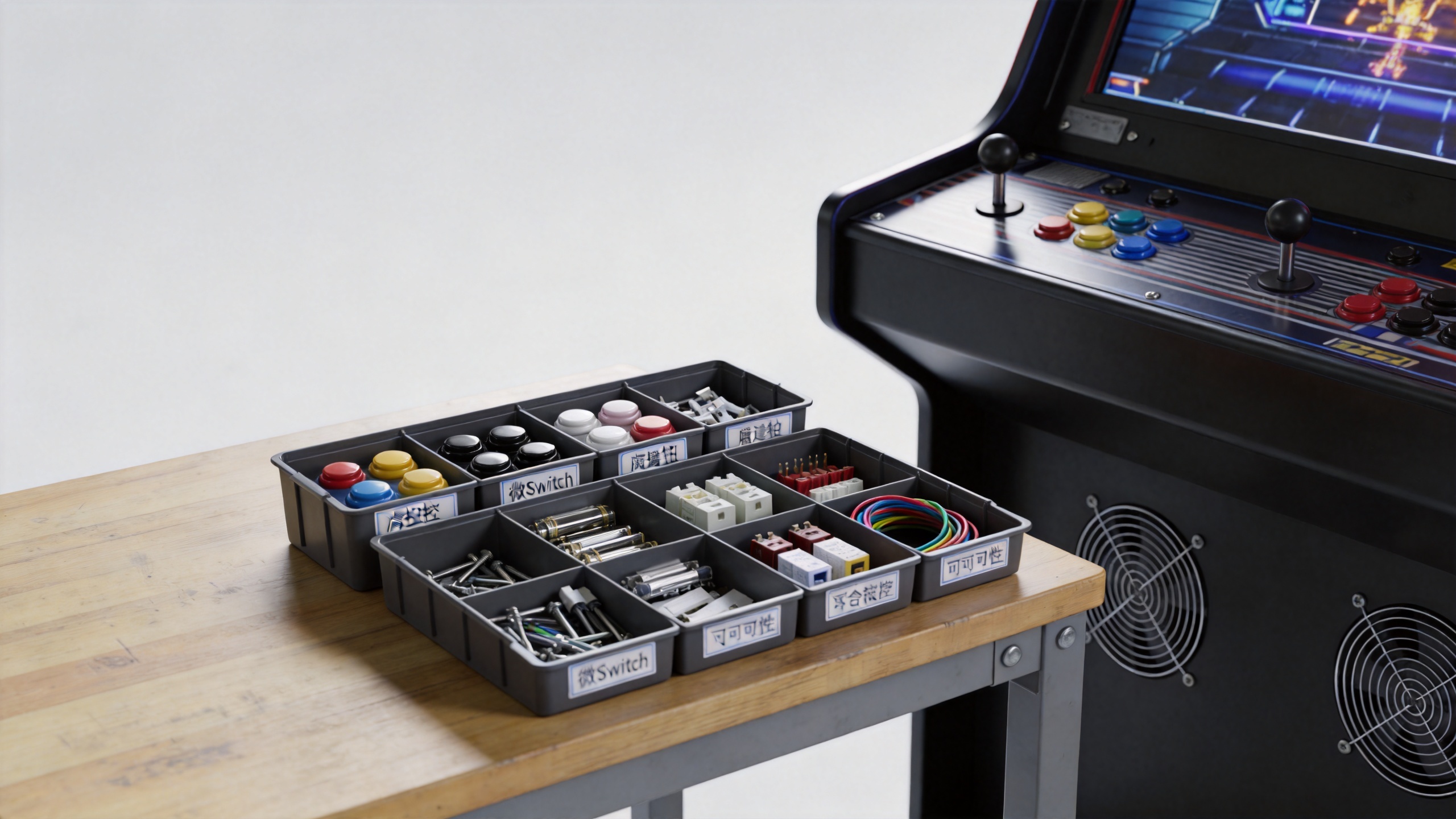
- Matching pushbuttons, microswitches, joystick switches or complete joystick assemblies
- Start buttons, service buttons, protective caps, springs, and compatible harness connectors
- Steering-wheel switches, pedal sensors, gun sensors, or other game-specific control wear items where applicable
These are often low-cost parts, but a missing match in color, diameter, voltage, or connector style can turn a five-minute repair into a long wait. Keep labeled sets by cabinet family rather than mixing loose components in one bin.
Power and basic electrical items
- Approved fuses in the correct ratings
- Power supplies that match the voltage, output, connectors, and cabinet model used on your floor
- Power cords, IEC leads, plugs, terminals, cable ties, crimp connectors, and heat-shrink tubing
- Fans, fan guards, filters, and compatible AC adapters where specified by the manufacturer
Do not substitute electrical parts merely because they appear similar. For amusement machines, the correct voltage, polarity, current capacity, grounding, and connector arrangement matter. Record approved replacement numbers and ask the manufacturer which substitutions are permitted.
Lighting, display, and audio basics
- Cabinet LEDs, lamp modules, LED drivers, and the specific connectors used by your cabinets
- Speaker units, volume controls, audio cables, and common display cables
- Monitor control boards or power boards only when your fleet uses repeatable, documented models
Complete displays and proprietary boards are usually better treated as planned-order items unless you operate several identical cabinets and a failure would have an unusually high impact.
Stock machine-specific parts by category
One universal parts box will not protect a mixed floor. Separate your inventory plan for each category of amusement machines.
| Machine category | Priority spare categories | Why they matter |
|---|---|---|
| Video arcade cabinets | Buttons, joysticks, switches, power supplies, fans, display cables | Restores basic playability and prevents heat-related interruptions. |
| Redemption games | Ticket-dispensing wear parts, sensors, belts, rollers, cutters, switches, and calibration-related components | Payout failures can stop play or disrupt prize-economy control. |
| Claw and merchandiser machines | Claw coils, limit switches, belts, strings, sensors, door locks, and payment-interface parts | Mechanical movement and prize-delivery systems are central to operation. |
| Driving and shooting games | Pedal sensors, steering components, gun parts, buttons, springs, and relevant harnesses | Player controls receive concentrated wear and directly affect the game experience. |
| Simulators and rides | Manufacturer-approved safety switches, emergency-stop components, fuses, indicators, and documented consumables | Safety-related parts require exact compatibility and controlled replacement procedures. |
For rides, motion attractions, and any equipment with safety functions, do not improvise. Follow the manufacturer’s maintenance schedule, parts list, and local inspection requirements. The correct part is more important than having a part quickly.
How many of each part should you hold?
There is no universal quantity that fits every venue. A sensible rule is to base the first purchase on fleet concentration, repair time, supplier lead time, and the cost of downtime. If you have several identical machines, holding more compatible spares makes sense. If one component is unique to a single older cabinet, identify the supplier and lead time, then decide whether its revenue contribution justifies carrying a backup.
Ask yourself: if this part fails on a busy weekend, can our team replace it safely, and can we obtain another one before the next peak period? If the answer is no, it belongs closer to the critical-spares shelf.
Start modestly, then adjust after three to six months of repair records. A larger inventory is not automatically better. Excess stock can become obsolete when you refresh the floor. The goal is a controlled stock level tied to actual failures and replenishment time.
Build a parts record that prevents wrong orders
The assumption that imported replacement parts will be available immediately is often corrected the hard way: a small failure can leave a cabinet idle while the team confirms which version, connector, or firmware revision is required. A good inventory system prevents that delay before the order is placed.
For every stocked part, record:
- Part name, manufacturer part number, and internal stock code
- Compatible machine model, cabinet revision, and serial-number range
- Photo of the item and its connector or label
- Bin location, quantity on hand, reorder point, and preferred supplier
- Last replacement date, failure symptom, and technician notes
- Whether replacement requires a trained technician, calibration, or a safety check
A simple spreadsheet can work at first. What matters is that staff can find the right component and see when stock is low without relying on memory.
Use preventive maintenance to improve the inventory
Your maintenance routine should feed your purchasing decisions. Log jams, intermittent buttons, weak audio, fan noise, payment issues, ticket faults, and error codes even when a quick reset gets the machine running. Repeated symptoms reveal which parts deserve a higher reorder point and which apparent “part failures” are really cleaning, cable, or configuration problems.
For operators managing a broad mix of arcade games, redemption machines, video simulators, and other amusement machines, supplier support also matters. A supplier that can provide accurate part numbers, maintenance documentation, remote technical guidance, and ongoing parts availability reduces the uncertainty around low-volume or proprietary components. Confirm those details when purchasing a new model, not after the first breakdown.
A practical first inventory checklist
- Correctly rated fuses and approved power-related consumables
- Compatible buttons, microswitches, joystick or control wear parts
- Common cables, connectors, terminals, and basic electrical repair consumables
- Fans, filters, and documented lighting or audio replacements
- Category-specific ticket, sensor, belt, roller, switch, or claw components
- Exact safety-related replacements required by the manufacturer for rides or motion equipment
- A parts register with compatible model information, supplier contacts, and reorder points
Match the inventory to each machine family
Use one record for every cabinet family, showing the model, revision, serial range, supplier, lead time, and technician notes. Video cabinets generally need approved controls, fuses, fans, and display cables. Redemption units often need documented sensors, belts, rollers, and ticket-path wear parts. Claw machines need compatible coils, strings, limit switches, and prize-delivery parts; driving or shooting games need their specified pedals, controls, sensors, and harnesses.
For motion attractions and rides, stock only manufacturer-approved service items and safety replacements. For cashless systems, document readers, cables, power items, and support contacts before a fault occurs. Review the register after every repair: when the same part is used twice, raise its reorder point; when a component no longer fits the fleet, retire it from active stock.
When adding a new cabinet, ask the supplier for part numbers, approved substitutions, maintenance instructions, and escalation contacts. Clear support files help distinguish equipment that warrants a dedicated backup from equipment that can rely on planned replenishment.
Final takeaway
An effective spare-parts inventory for amusement machines is built around the failures that can stop your busiest equipment and the lead times you cannot afford to absorb. Keep fast-moving, compatible parts on site; document rare or proprietary components before you need them; and let maintenance records refine your stock over time. That approach protects uptime without tying unnecessary capital up in bins of parts that do not fit the machines you actually operate.


 Hot News
