
 EN

How Do Amusement Machines With Augmented Reality Compare to Pure VR Experiences?
Venue buyers comparing amusement machines with augmented reality (AR) and pure virtual reality (VR) should look beyond the demo. The relevant question is how each attraction fits the guest journey, floor plan, staff routine, and surrounding game mix. AR-based amusement machines keep the real setting visible while layering digital effects over it. Pure VR amusement machines place the player inside a computer-generated scene. Both formats can be compelling, but they create different operating demands.
What changes when AR replaces pure VR?
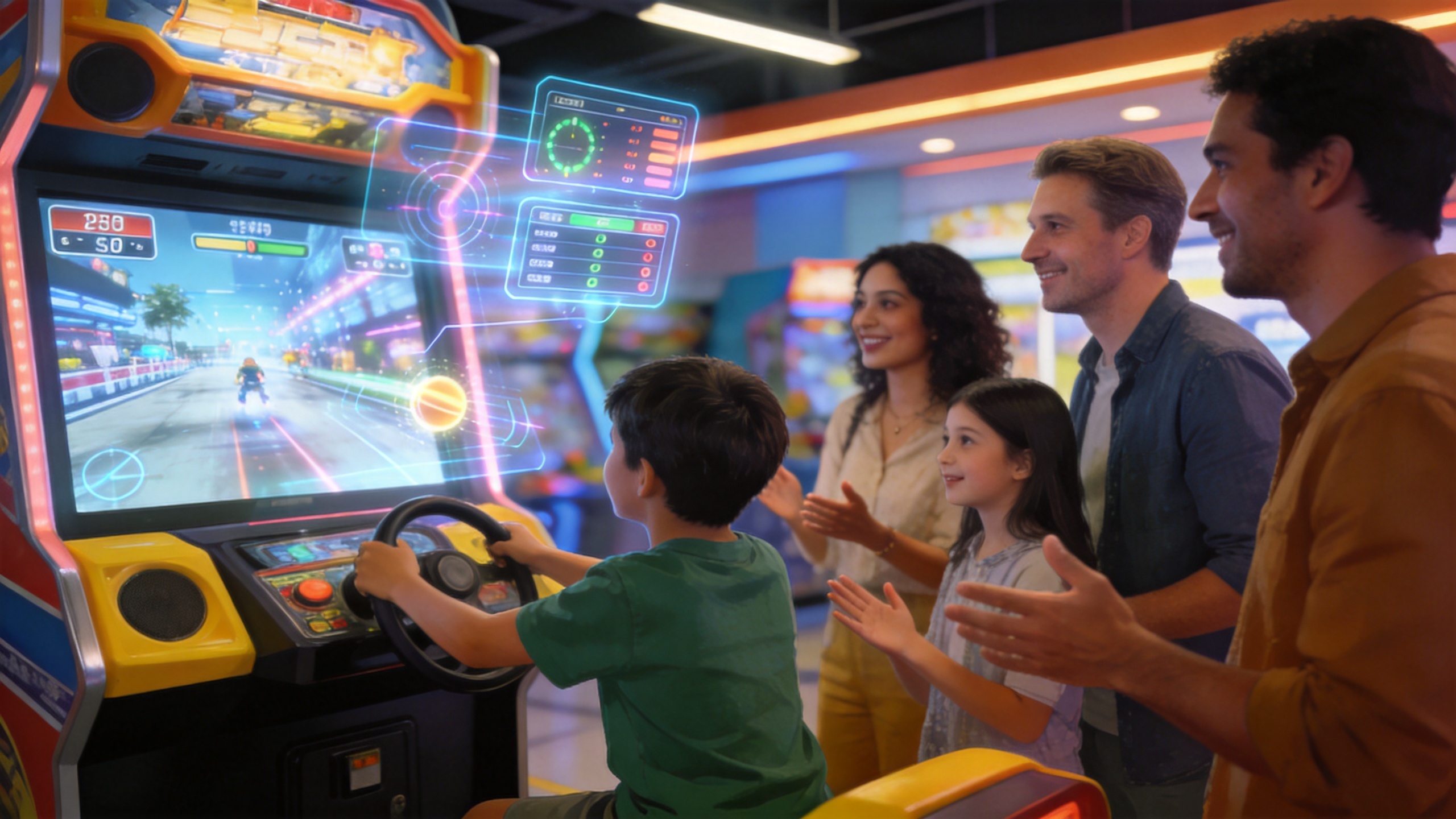
AR amusement machines combine physical controls, a cabinet, a ride platform, or a play zone with animated targets and effects. Players can still see companions, staff, and parts of the venue. That makes these amusement machines easier to understand from the queue and can help spectators follow the action. The physical environment remains an active part of the experience rather than disappearing behind a headset.
Pure VR amusement machines do the opposite: the headset becomes the player’s visual world. This can create a dramatic sense of scale for racing, missions, exploration, and cinematic scenes. It also means that VR amusement machines need clear fitting, orientation, and exit procedures. A short onboarding step may be worth it when the venue wants a more destination-style attraction; it may be less suitable when fast, casual play is the priority.
Guest experience and spectator appeal
One reason AR amusement machines work well in an open arcade is that nearby guests can usually read the interaction. They can see a player aiming, steering, moving, or responding to a visible challenge. When the next guest understands the game quickly, AR amusement machines can support a simple watch-then-play pattern. This can be useful for families, mixed-age groups, and high-traffic areas where the attraction itself should help create energy.
VR amusement machines can provide a more private, concentrated point of view. That is a strength for story-led play, simulations, and cooperative missions. But people outside the headset may need a monitor, an operator explanation, or a visible reaction from the player to understand the scene. For this reason, VR amusement machines often benefit from a dedicated zone rather than relying only on walk-by interest.
AR versus VR for venue operations
| Decision factor | AR-enabled amusement machines | Pure VR experiences |
|---|---|---|
| Physical awareness | Players remain connected to visible controls and the surrounding venue. | Players see a digitally rendered environment through the headset. |
| Guest onboarding | Often familiar to guests accustomed to screen-led amusement machines. | Usually includes headset fitting, instructions, and boundary awareness. |
| Spectator visibility | Action is commonly easier for companions to follow. | An external display can make the experience more legible to observers. |
| Reset routine | Focuses on controls, sensors, screens, and physical presentation. | Focuses on headset readiness, cleaning, tracking, and safety checks. |
Commercial amusement machines should be evaluated by the full guest cycle, not only by play time. Map the invitation, queue, setup, play, exit, cleaning or reset, and handoff to the next player. AR amusement machines may have a lower-friction start because the guest remains oriented in the room. VR amusement machines may need more active staff support, particularly during busy periods or for first-time players.
Shared-headset hygiene is a practical consideration for VR amusement machines. Operators need a routine for inspection, cleaning, storage, and visible communication that reassures guests. Reliability also matters: location-based equipment runs for long venue hours, so buyers should ask about routine maintenance, replacement parts, software updates, and the reset process. AR amusement machines have their own maintenance needs, including displays, sensors, cabinets, and motion components where applicable.
Comfort, safety, and accessibility
AR amusement machines can be approachable for guests who want to stay aware of their companions and surroundings. They still need readable instructions, clear paths, appropriate reach ranges, and controls that do not overwhelm players. A well-designed AR attraction makes it obvious where to stand, what to hold, and when a round begins or ends.
With VR amusement machines, operators should plan for motion sensitivity, balance concerns, vision correction, age guidance, and the possibility that a player wants to stop early. Staff need an easy way to assist without disrupting others. Local requirements and the supplier’s operating guidance should shape each site’s safety procedures. Neither AR nor VR amusement machines should be treated as a one-size-fits-all solution for every audience.
Where each format belongs
Choose AR-focused amusement machines when visible action, easy participation, and social play are central to the venue. They can fit near family zones, entry areas, or busy arcade paths where the attraction should invite attention. Choose pure VR amusement machines when the objective is a longer, more enveloping experience with a clear story or simulation. A separate VR area can give staff room to manage fitting and flow.
Many operators benefit from using both types of amusement machines. AR can provide fast, observable engagement, while VR can offer a deeper scheduled session. This combination gives guests a choice between low-barrier participation and a more immersive commitment.
A practical buying checklist
- Define the target guest and the desired length of play.
- Measure attraction footprint, queue space, staff access, and safe entry and exit paths.
- Watch whether guests can understand the attraction before they play.
- List every reset task for the shortlisted amusement machines and assign who completes it.
- Ask about cleaning, inspection, updates, spare parts, and training.
- Run a trial using the same session length and staffing level planned for the venue.
The useful choice is the one that fits
AR and pure VR bring different strengths to amusement machines. AR connects digital play to a shared physical setting; VR can transport a player into a distinct digital world. Compare the entire guest cycle, the staff workload, and the role the attraction will play on the floor. When those factors align, the chosen amusement machines can make sense as part of a broader entertainment experience.



 Hot News
