
 EN
What Certifications Should a Reliable Amusement Machine Manufacturer Hold?
When buyers compare an amusement machine manufacturer, price and cabinet appearance may be easy to judge from a quotation. Certification evidence is harder to assess—and more important. A credible amusement machine manufacturer should be able to explain which compliance documents apply to the equipment, the intended market, and the installation conditions. The practical question is not “Does the amusement machine manufacturer have a certificate?” but “Can it provide current, model-relevant evidence for this order?”
For importers, family entertainment centers, distributors, and arcade operators, that distinction reduces the chance of receiving equipment that causes inspection delays, insurance questions, or costly rework. The checklist below separates amusement machine manufacturer-level management credentials from product-level compliance evidence, because one does not replace the other.
Start With the Difference Between a Certificate and Product Compliance
An amusement machine manufacturer may hold a management-system certificate, a product test report, a declaration, or a market-specific approval. These documents serve different purposes. ISO 9001, for example, concerns a amusement machine manufacturer’s quality management system. It can indicate that the amusement machine manufacturer has documented processes for areas such as production control, corrective action, and traceability, but it does not by itself prove that every arcade machine is compliant in every destination market.
Likewise, a CE mark is not a universal quality badge. For products placed on the European Economic Area market, it may be required where applicable EU rules apply. Buyers should therefore ask the amusement machine manufacturer to identify the relevant legal basis and technical documentation for the exact model, rather than accept a logo on a brochure as the full answer.
1. ISO 9001: A Useful Baseline for amusement machine manufacturer Process Control
ISO 9001 certification is one of the first credentials to request from an amusement machine manufacturer. It is particularly useful when you are evaluating a new amusement machine manufacturer remotely, because it focuses on whether the amusement machine manufacturer operates a repeatable quality-management system rather than relying only on individual inspection efforts.
Still, verify the details. Ask for a current certificate, the name of the issuing certification body, its validity dates, and the certified scope. The scope should make sense for the amusement machine manufacturer’s actual activity—such as manufacturing, assembling, or supplying amusement and arcade equipment. If the certificate scope is unrelated to the quoted products, treat it as limited evidence.
In a commercial arcade setting, consistent process control matters after shipment as much as before it. A amusement machine manufacturer that can trace production batches, retain inspection records, and manage corrective actions is generally easier to work with when a control panel, ticket mechanism, or electronic part needs follow-up.
2. CE-Related Documentation for Applicable EEA Sales
If your equipment will be sold or installed in the EEA, ask the amusement machine manufacturer which EU requirements apply to the particular machine. Depending on its design and electrical configuration, the documentation may need to address areas such as machinery safety, electrical safety, electromagnetic compatibility, or restrictions on hazardous substances. The applicable route is product-specific, so a blanket answer is not enough.
A reliable amusement machine manufacturer should be prepared to provide a model-specific declaration of conformity where appropriate, relevant test reports or risk-assessment evidence, technical specifications, operating instructions, warnings, and marking information. Where a third party has issued a report, check that the report identifies the model or a clearly defined product family and that key components have not changed since testing.
There is an important practical correction here: “CE certified” is often used loosely in sales conversations. For many products, the manufacturer carries conformity-assessment responsibility and creates the declaration; it is not necessarily a stand-alone certificate issued by an outside authority. Asking for the underlying documentation is more useful than asking only for a CE certificate.
3. Safety Standards Relevant to Rides, Devices, and Venue Requirements
For amusement rides and devices, technical standards can be as significant as formal certificates. ASTM Committee F24 develops standards for the amusement-ride and device industry. In North American projects, an operator, insurer, designer, or local authority may reference ASTM standards in specifications or safety discussions. Other markets may use different national or regional standards, so the buyer should first confirm the project’s governing requirements.
Ask the amusement machine manufacturer to map its evidence to your machine category. A coin-operated video game, a redemption machine, a children’s ride, and a large mechanical attraction do not carry the same risks or documentation needs. For a ride-like device, useful records may include design and risk-assessment files, load or functional test records where applicable, safety-label artwork, installation instructions, maintenance schedules, and inspection guidance.
No responsible amusement machine manufacturer should promise that one standard automatically satisfies every local rule. Site approvals can depend on installation, anchoring, power supply, emergency access, operator procedures, and local inspection requirements. Conditional guidance is more trustworthy than a blanket guarantee.
4. Electrical, EMC, and Component Evidence
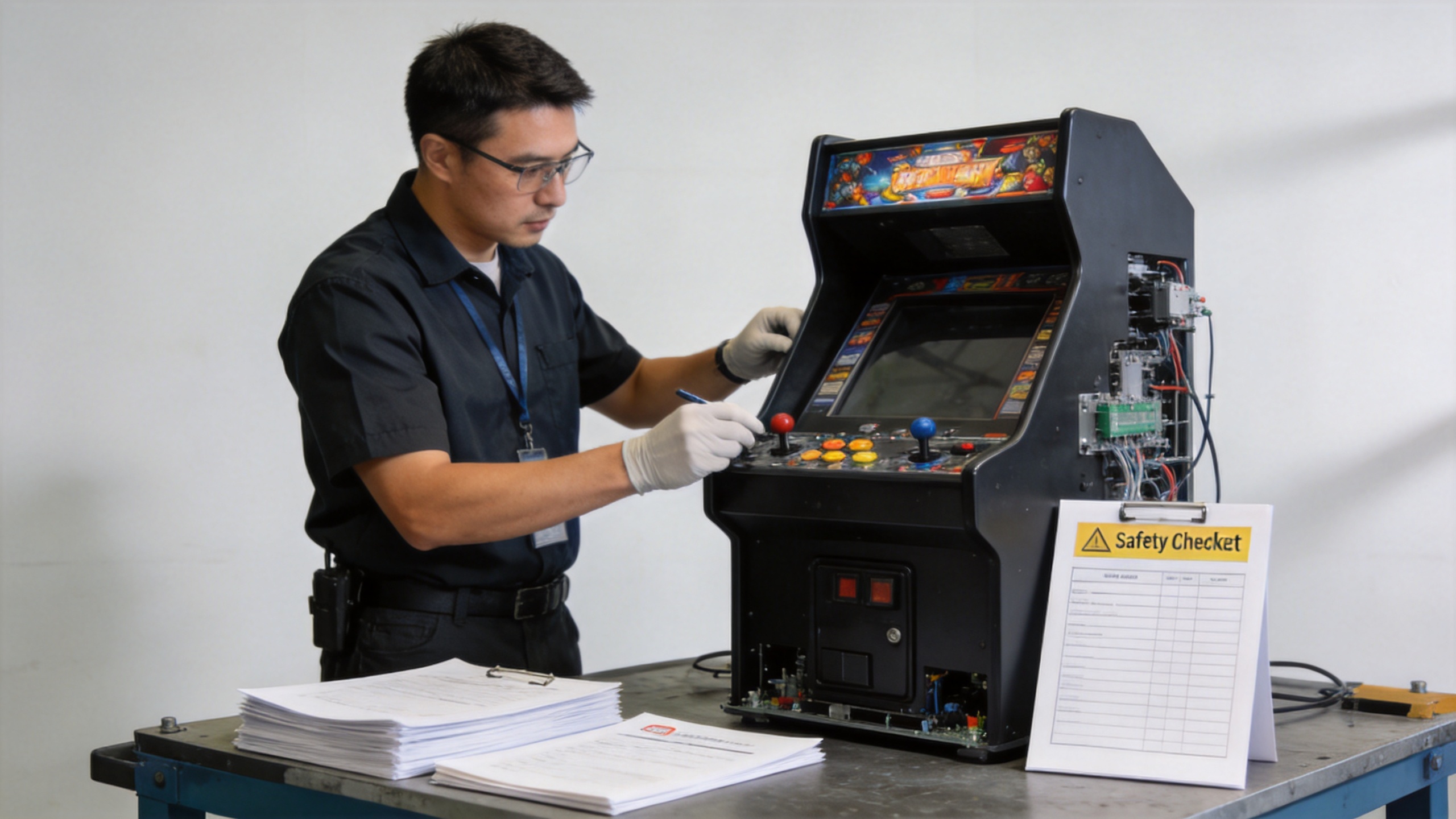
Many arcade and redemption products combine low-voltage electronics, displays, power supplies, motors, sensors, lighting, and payment or ticket systems. That means buyers should look beyond the cabinet and ask about the electrical evidence behind the finished product. A capable amusement machine manufacturer should be able to identify the electrical specifications, protection measures, wiring documentation, and relevant component records for the quoted configuration.
For export orders, compare the documentation against the destination’s voltage, plug, frequency, language, labeling, and radio-function requirements. If the machine contains wireless modules, cashless payment hardware, or networked features, additional rules may apply. This is exactly where early document review can prevent an otherwise avoidable delay at installation.
5. Environmental and Material Compliance When the Market Requires It
Environmental compliance is often part of an export buyer’s due diligence. Depending on the market and the product, the order may require evidence related to restricted substances, electronic waste obligations, batteries, packaging, or materials. These obligations are not interchangeable, and not every one applies to every amusement product.
Instead of asking for a generic environmental certificate, provide the destination country and product configuration. Then request a written compliance matrix showing what the amusement machine manufacturer can support, which parts are covered, and which documents apply to the shipment. This approach is more dependable than relying on broad marketing language.
How to Verify an Amusement Machine Manufacturer Before You Buy
- Give the amusement machine manufacturer the destination and use case. State whether the equipment is for an arcade, FEC, mall, park, or distributor stock, and identify the country or region.
- Request model-level evidence from the amusement machine manufacturer. Ask for documents tied to the exact cabinet, revision, electrical configuration, and accessories on the quotation.
- Check scope and validity with the amusement machine manufacturer. Verify ISO 9001 scope, issuing body, dates, document numbers, and whether reports cover the actual product family.
- Review the amusement machine manufacturer’s document package together. Include manuals, warning labels, wiring information, declarations, test reports, packing records, and spare-parts support information where relevant.
- Plan the site side separately. Confirm local installation, licensing, inspection, and insurance needs with the appropriate local professionals or authorities.
Questions That Reveal Whether the amusement machine manufacturer Is Prepared
- Which certifications or declarations can the amusement machine manufacturer support for this exact model in my destination market?
- Can the amusement machine manufacturer provide current copies, the certificate scope, and model references before I place the order?
- What changes would require the amusement machine manufacturer to update documents or testing?
- Which electrical configuration, plug type, labels, and manuals will the amusement machine manufacturer supply?
- What pre-shipment inspection records and after-sales technical documents can the amusement machine manufacturer provide?
Choose Evidence, Not Just Logos
A reliable amusement machine manufacturer should make compliance part of the buying conversation early, especially for international orders. ISO 9001 can support confidence in amusement machine manufacturer process control. CE-related documentation may be essential for applicable EEA sales. ASTM F24 or other relevant technical standards can help frame project safety expectations. Yet none of these should be treated as a one-size-fits-all pass.
The strongest amusement machine manufacturer relationship is built on traceable, current, model-specific documentation and candid discussion of what still needs local verification. It may be less dramatic than a wall of certificate logos, but it gives buyers a clearer basis for safer, more defensible purchasing decisions.


 Hot News
