
 EN

What Should You Look for When Buying Arcade Game Machines From China?
Buying commercial arcade game machines from China can give a venue operator or distributor access to a broad range of cabinet formats, redemption games, and simulator attractions. But the first price quotation should be the beginning of due diligence, not the end of it. The practical question is whether a supplier can deliver machines that fit your audience, arrive in the agreed condition, and remain serviceable after installation.
From a procurement perspective, the useful comparison is not simply factory price versus local price. It is the total operating picture: product fit, documentation, packing, commissioning, spare parts, and how a supplier handles a problem after delivery. The checklist below helps buyers evaluate an arcade order before a deposit is paid.
1. Start with the venue, not the catalog
Arcade procurement works when every proposed arcade machine is matched to a defined operating role on the floor rather than selected solely from a catalog image.
An arcade machine that draws attention in a showroom can be a poor fit for a particular floor. Define the intended players, available footprint, ceiling and doorway access, power supply, payment system, and staff capability before requesting quotes. Family entertainment centers may need a balanced mix of accessible games and redemption formats, while a competitive or adult-focused venue may prioritize multiplayer play, game depth, and visual impact.
Ask for complete information for each shortlisted model: cabinet dimensions, packed dimensions, weight, electrical requirements, player capacity, operating instructions, and maintenance access points. This matters especially for large machines. A unit can fit on a floor plan yet still be difficult to bring through a service entrance or lift. If your venue uses card or cashless systems, verify compatibility in writing rather than assuming that a coin-operated configuration can be converted later.
2. Evaluate build quality through evidence
For commercial arcade equipment, a short evidence review now can reduce the chance of an expensive mismatch after an arcade shipment reaches the venue.
Photos alone tell very little about long-term commercial use. Request current factory video of the exact or equivalent model operating, close-view images of controls and cabinet joins, and a written component list where available. For an arcade purchase, inspect the parts that receive repeated player contact: buttons, joysticks, ticket mechanisms, coin or card interfaces, screens, speakers, doors, locks, wiring, cooling, and service panels.
Here is the important shift: early conversations tend to focus on unit price. After the first significant repair, parts availability and technical response time often become more important. Ask which components are standard, which are proprietary, and which consumable or wear parts the supplier keeps in stock. A supplier should be able to explain how faults are diagnosed, what evidence is needed for a support request, and how replacement parts are identified.
3. Verify the supplier, factory, and communication process
A dependable arcade supplier makes the arcade production process visible and assigns clear owners for technical, commercial, and service questions.
Factory location by itself is not proof of capability. Request a live video walk-through, production photos tied to your order, and a clear contact path for sales, technical questions, and after-sales support. If the order value justifies it, arrange a visit or use an independent inspection provider. A transparent supplier should be comfortable discussing production stages, quality checks, packaging, and escalation procedures.
Also test communication before placing the order. Send a technical question that requires a specific answer, such as voltage configuration, drawing revision, packaging method, or spare-parts process. The quality and clarity of the response is a useful indication of what support may look like later. Language and time-zone differences are manageable when responsibilities and response channels are established early.
4. Treat compliance and electrical configuration as pre-order tasks
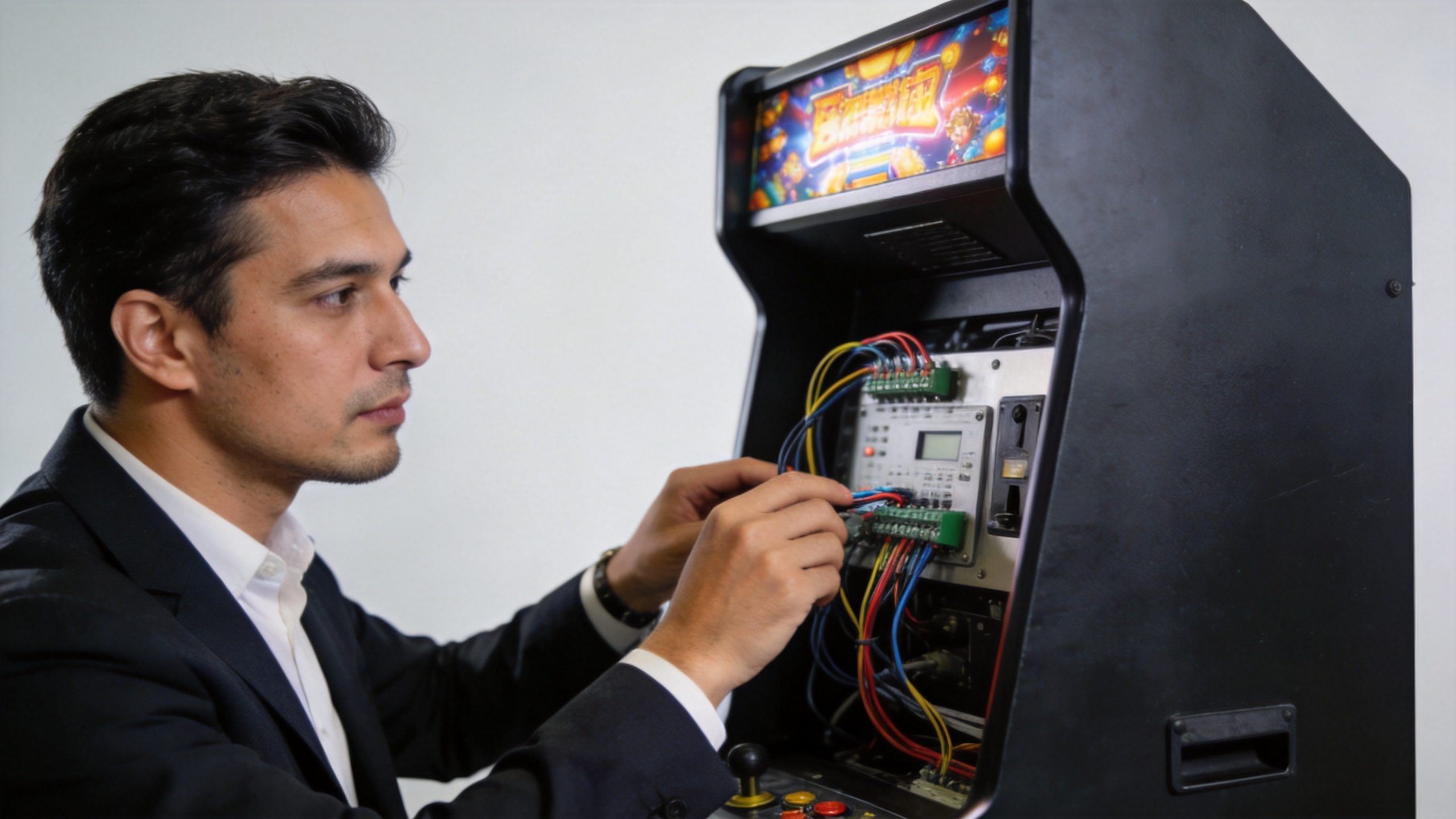
Compliance review belongs in the arcade purchasing plan before production begins, because an arcade configuration may need to match local venue and electrical conditions.
Do not leave destination-market requirements until the machines are ready to ship. The applicable safety, electrical, electromagnetic-compatibility, labeling, and venue requirements depend on where the equipment will be installed and how it will be operated. Ask your local authority, insurer, or qualified importer which documents are relevant to your project, then ask the supplier precisely what they can provide for the selected models.
Confirm voltage, frequency, plug type, grounding requirements, circuit load, and any required operator labels in the purchase specification. Do not rely on a general statement that a machine is suitable for export. Documentation should identify the model and configuration you are actually buying. If a document is necessary for local licensing or insurance, review it before final payment and, when appropriate, have a local specialist validate it.
5. Put pre-shipment acceptance criteria in writing
Set an arcade acceptance standard before the arcade factory schedules final testing, not after the arcade cargo is packed.
A pre-shipment inspection is one of the clearest ways to reduce ambiguity. Your checklist can include model and quantity confirmation, external finish, cabinet dimensions, electrical configuration, display and sound test, game start-up, controls, ticket or payment functions, accessories, manuals, serial or model labels, and packaging condition. Request dated photos or video of the inspection and keep the approved checklist with the order records.
For a multi-unit arcade shipment, test more than one machine when possible. Make the acceptable defect standard and remedy process clear in the contract. This is not about expecting flawless logistics; it is about agreeing on the evidence needed to resolve a mismatch before the cargo leaves the factory.
6. Review packaging, shipping, and import responsibilities
Every arcade shipping plan should connect the arcade factory, freight partner, importer, and receiving team through the same written records.
Arcade cabinets are bulky and can contain screens, lighting, moving mechanisms, and sensitive electronics. Ask how each model is protected for the intended transport route, whether pallets or crates are used, how cartons are labeled, and which parts are removed or secured for transit. Obtain packed dimensions and weights early so your freight partner can plan container space, unloading equipment, and delivery access.
Clarify the agreed trade terms, handover point, insurance responsibility, and document set. Your customs broker should confirm product classification, import duties, and destination-specific paperwork before the goods are dispatched. A supplier can assist with export documentation, but the importer remains responsible for verifying local import and operating obligations.
7. Compare after-sales support, not just warranty wording
The long-term value of an arcade supplier depends on whether arcade operators can obtain clear technical help and usable parts when a machine is offline.
A warranty paragraph has little value if the process for using it is unclear. Ask what is covered, how long coverage applies, what evidence is required, whether remote troubleshooting is offered, and who pays for parts or freight in different situations. More importantly, request the parts list, recommended spares, troubleshooting guide, and an estimated process for obtaining replacements.
For an arcade venue, downtime is an operating issue, not just an inconvenience. A clear maintenance plan can include daily checks, cleaning intervals, calibration tasks, staff training, and a small on-site spares kit for items that are likely to wear. If you are buying for multiple locations or resale, ask whether the supplier can support serial-number tracking and consistent documentation across the order.
8. Use a comparison sheet before you choose
Use the same arcade comparison sheet for every supplier so that an arcade quotation is assessed against the same operational requirements.
| Area to compare | Questions to ask | Evidence to keep |
|---|---|---|
| Machine fit | Does it suit the audience, floor plan, payment system, and power supply? | Specification sheet and layout review |
| Supplier capability | Can the factory show production, inspection, and support processes? | Video call notes and written responses |
| Compliance | Which destination-market documents and labels are needed? | Model-specific documents reviewed before shipment |
| Shipment readiness | How are units tested, packed, labeled, and insured? | Inspection checklist, packing list, photos |
| Lifecycle support | How are faults diagnosed and parts supplied? | Warranty terms, spares list, support contacts |
Final takeaway
A disciplined arcade buying process makes arcade supplier comparisons more transparent and gives the receiving team clearer expectations before equipment is dispatched.
The lowest quoted price may be relevant, but it is only one decision input. A well-planned arcade purchase from China is built around verified product fit, model-specific requirements, documented inspection, sensible shipping preparation, and a support process that continues after commissioning. If you make those checkpoints part of the quotation and contract stage, you will have a stronger basis for comparing suppliers and planning a reliable venue rollout.


 Hot News
