
 EN

Why Are Multiplayer Arcade Shooting Games Making a Comeback in 2026?
Multiplayer arcade shooting games are reappearing on more entertainment floors in 2026 because they solve a very physical problem: they turn passing interest into a shared moment people can see, join, and talk about. A player standing at a cabinet may be engaged, but two or four players reacting together create a small event. For an arcade operator, that difference matters. It can make a game readable from across the floor, encourage a group to wait for the next round, and give visitors a reason to return with friends.
The comeback is not simply nostalgia for light-gun cabinets. Modern visitors already have powerful solo games at home. What the arcade adds is the public, low-friction version of competition: no downloads, no accounts, no long tutorial, and no need to persuade everyone to play the same title before a night out. Players can step up, choose a side, and start. That immediate social entry point is becoming useful again as venues compete for group occasions rather than just individual transactions.
Shared action is visible entertainment
In an arcade, the most persuasive advertising often happens on the floor. A multiplayer shooting game gives bystanders several cues at once: large on-screen movement, score changes, cooperative callouts, and the occasional close finish. The result is easy to understand even for someone new to the format. Search results for arcade venues in 2026 also lean heavily toward group entertainment, family outings, bar-style social play, and mixed activity destinations. That does not prove every shooting cabinet will perform the same way, but it does show why social formats belong in the conversation.
Here is the important distinction: a loud cabinet is not automatically a social one. The games that invite a second player make the next action obvious. A clear start button, visible player stations, short rounds, and readable win-or-lose feedback help people join without feeling that they have interrupted an expert. That is why a compact cooperative mission can draw more repeat play than a technically elaborate experience with a slow setup.
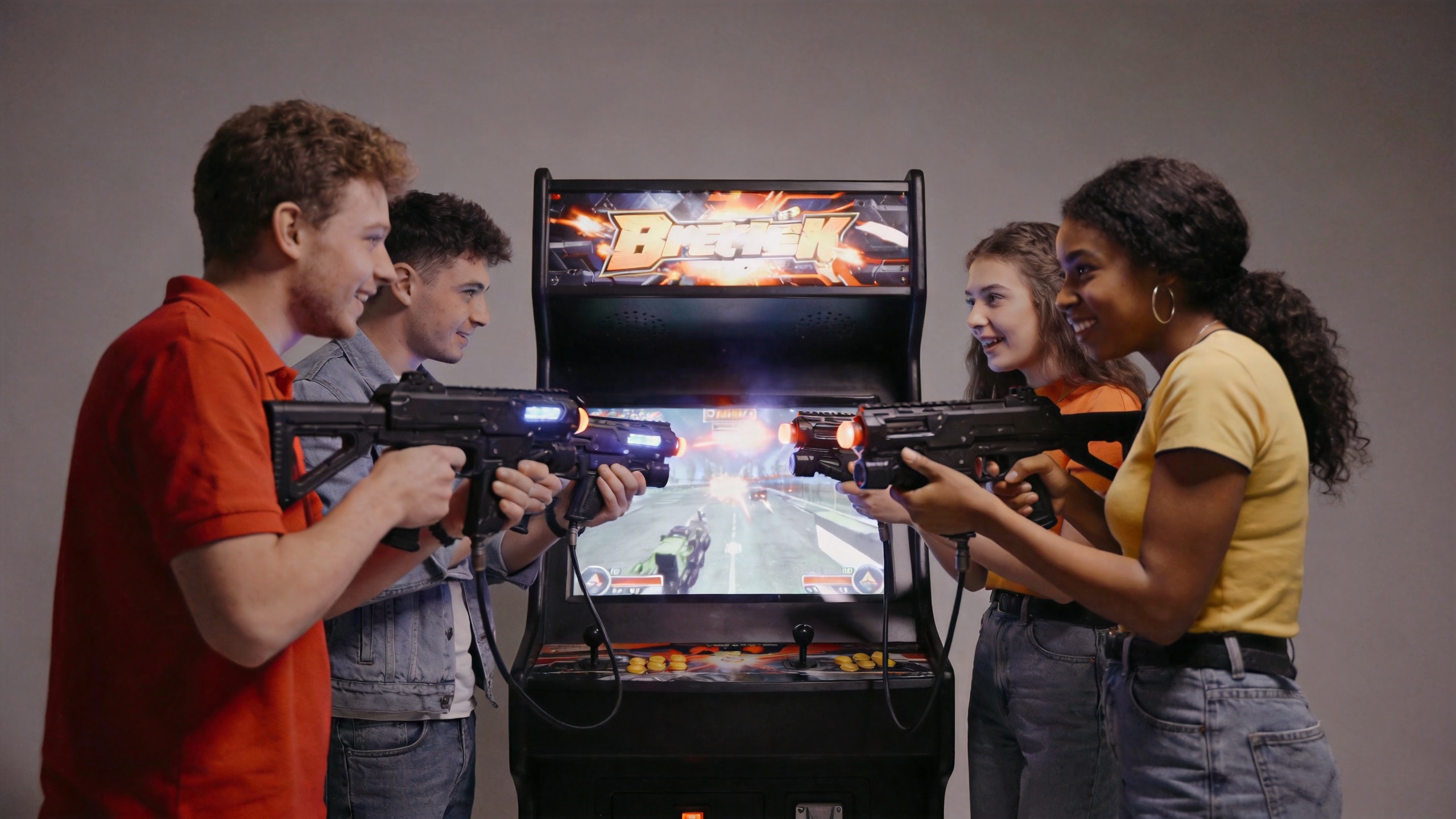
Why the shooting format fits the moment
Shooting games naturally create a common focal point. Players look at the same screen, respond to the same threats, and compare scores in real time. Cooperation supplies one kind of conversation; friendly rivalry supplies another. The format also works across a reasonably wide age range when the theme, controls, and content are matched to the venue. For a family-focused arcade, approachable visuals and forgiving difficulty may matter more than competitive depth. For an adult venue or a location with regular players, leaderboards, alternate routes, and short skill loops can give visitors a reason to test themselves again.
Broader games-market search results point to multiplayer interaction and competitive play as ongoing demand drivers. That context is useful, but an operator should not treat it as a purchase instruction. A console or mobile trend does not transfer automatically to a physical arcade floor. The advantage of the cabinet is not that it copies home gaming. Its value lies in the dedicated controls, the shared screen, the high-visibility presentation, and the fact that the group is already together in the venue.
The return of short, satisfying sessions
Many guests now move through an entertainment venue in groups with limited time and competing choices. Multiplayer arcade shooting games fit that rhythm because a round can deliver a beginning, a burst of tension, and a result before the group moves on. There is no need to commit to an hour-long session. That makes the format useful beside redemption, racing, sports, and other quick-play attractions.
To be fair, newer immersive formats can create strong initial buzz. Where they sometimes fall short is in throughput and ease of entry. A multiplayer shooting cabinet can often be understood in seconds, while a more involved attraction may require preparation, staffing, or a longer reset. That does not make one category universally stronger than the other. A balanced arcade floor can use immersive attractions as destination pieces and multiplayer shooters as visible, repeatable traffic drivers.
What operators should look for before adding one
Before selecting a multiplayer shooter, ask a practical question: are you filling a gap in an existing arcade, or building a new floor mix? The answer changes what matters. An existing venue may need a cabinet that complements nearby categories and fits a known audience. A new venue may need a game that is simple enough to communicate its value before visitors know the layout.
- Player capacity and waiting behavior: Two-player and four-player formats create different crowd patterns. Watch whether onlookers stay for the next round or leave the area.
- Round length and restart clarity: Short sessions work well only when players can see how to begin again or invite another person in.
- Placement: Put the game where its screen, sound, and player activity can be noticed without blocking circulation. A corner can hide even an engaging cabinet.
- Control comfort: Trigger feel, cabinet height, reach, and sightlines influence whether younger guests and mixed groups stay involved.
- Service planning: Review access to controls, displays, software support, spare parts, and pre-shipment testing before the purchase decision.
This last point is easy to minimize during a demo. In day-to-day arcade operation, a cabinet that is difficult to service can lose value quickly when a high-touch control needs attention. A supplier conversation should cover support and parts availability alongside game theme and cabinet appearance.
Social proof is becoming part of the game loop
One reason multiplayer arcade shooting games are returning is that they make their own social proof. People notice a close score, hear teammates coordinating, or see someone pull a friend into the next round. That kind of attention is different from advertising because it is created by the guests themselves. Queue behavior is not a complete performance metric, but it is a useful early signal. If people consistently wait, watch, and take turns over several busy periods, the cabinet is doing more than processing isolated plays.
An operator can support that loop with simple choices: keep the score display legible, make player stations easy to identify, avoid burying the game behind taller cabinets, and place nearby attractions so a group can continue its visit after a round. The goal is not to turn every arcade into a shooting-game zone. It is to use the category where it adds energy to the wider mix.
Designing the arcade moment, not just the game
A multiplayer shooter is strongest when the arcade experience around it is deliberate. The arcade cabinet needs a clear approach path, while the arcade floor needs enough space for friends to gather without stopping circulation. In a busy arcade, a visible join point lets a second guest understand the invitation immediately. In a smaller arcade, the same cabinet may need quieter neighboring attractions so its score and player reactions remain legible.
Operators can test the fit through ordinary arcade observation: who starts a round, who joins, and whether the group stays in the arcade afterward. Does the arcade game prompt another round? Does it send guests toward another arcade attraction? Those questions are more useful than an isolated first-day total. A successful arcade placement often builds a small sequence: watch, play, compare scores, then continue through the arcade.
That sequence also helps a mixed arcade floor feel well integrated. A social shooter can act as an arcade energy point between family games, redemption, and other group attractions. The right arcade choice depends on audience and service capacity, but the evaluation should measure its contribution to the whole arcade visit rather than treating it as a standalone screen.
For an arcade team, the practical test is simple: can guests understand the arcade game at a glance, join the arcade game with a friend, and remember the arcade moment after they leave? A well-positioned arcade shooter encourages conversation before play and comparison afterward. That is why the arcade format can support a social visit without requiring a complex explanation. The arcade cabinet becomes a meeting point, not merely another screen.
There is also a maintenance dimension. A reliable arcade machine keeps its social promise only when controls are responsive and the arcade game is available during busy periods. During supplier evaluation, an arcade operator can ask how the arcade cabinet will be serviced, which parts are available, and how support works after delivery. Those answers affect whether the arcade floor can preserve the experience that drew a crowd.
The 2026 takeaway for arcade venues
Multiplayer arcade shooting games are making a comeback because they deliver something home play and passive entertainment cannot easily reproduce: a spontaneous shared challenge in a public space. Their appeal comes from social visibility, quick participation, approachable competition, and a format that can suit families, friends, and regular players when selected carefully.
For an arcade operator, the sensible next step is not to chase every new release. Start with the venue: who visits, how groups move through the floor, what categories already attract a crowd, and what support the business can maintain. Then evaluate whether a multiplayer shooter can create a clear, repeatable moment within that environment. When the fit is right, the comeback is less about looking backward and more about giving people a reason to play together now.


 Hot News
