
 EN

How to Choose Between Single-Player and Twin Racing Game Cabinets for Your Venue?
Choosing a racing game cabinet is not simply a question of buying one seat or two. For a family entertainment center, arcade, bowling venue, mall location, or resort, the cabinet has to fit traffic patterns, guest behavior, staff routines, and the role you want it to play on the floor. As an arcade equipment technical specialist, I start with the operating setting rather than the cabinet price: a racing game that works well in a compact location may not create the same experience in a social venue.
The practical choice is usually between a single-player racing game cabinet and a twin cabinet designed for head-to-head play. Neither format is automatically right. The useful question is: what kind of moment do you want guests to have, and how will that moment work during your busiest periods?
Start With the Job the Racing Game Must Do
A single-player racing game is often a focused, independent attraction. A guest can step in, play a short session, and leave without waiting for a companion. That can suit locations with narrow aisles, mixed-age traffic, or a floor plan where several different attractions need to share limited space.
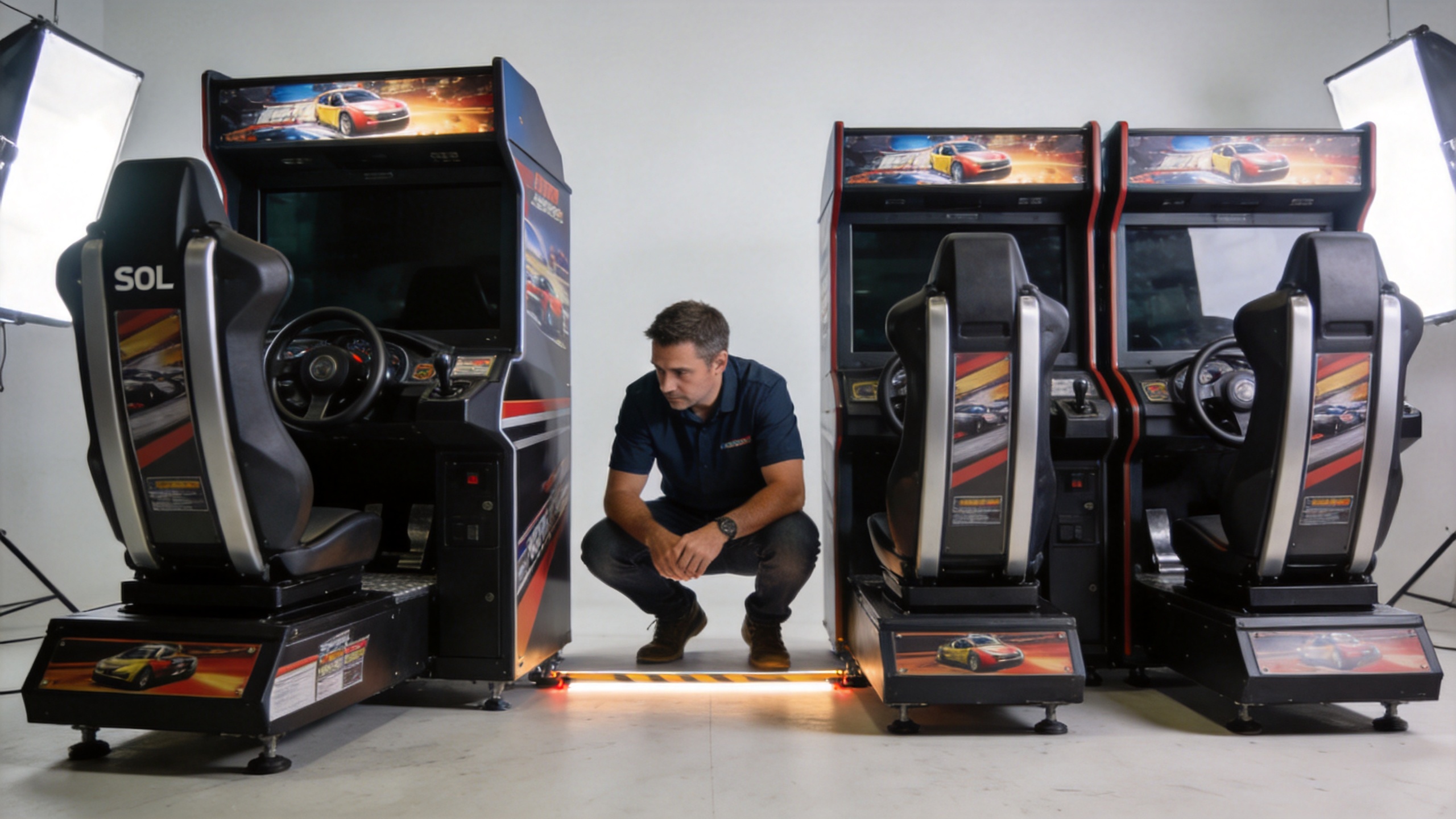
A twin racing game, by contrast, makes the interaction visible. Two seats, two steering positions, and a shared screen moment can draw attention from passersby. It is not merely twice the hardware—or rather, that is not the main reason to choose it. Its value is the direct challenge between players and the small audience that often forms around an active race.
Before comparing models, ask yourself one pointed question: are you filling an empty corner, or are you building a social zone that should keep a group engaged together? The answer changes which racing game format deserves priority.
Compare Space, Sightlines, and Guest Flow
Floor space is the first practical filter. A single-player racing game cabinet can be easier to position along a wall or in a row with other arcade equipment. It can also leave more room for circulation, strollers, queues, and staff access. This does not mean a solo cabinet belongs everywhere; it means the location can use a racing game without making the entire area depend on one attraction.
A twin racing game cabinet needs enough clearance for two players to enter, sit, and exit comfortably. It also benefits from clear front and side sightlines. When it is placed where people can see the competition but not block the aisle, the cabinet can become a natural focal point. When it is squeezed into a passageway, the same twin layout may create congestion and make routine cleaning or service less convenient.
| Venue question | Single-player cabinet | Twin cabinet |
|---|---|---|
| Available footprint | Often easier to fit into a smaller opening | Needs space for two seats and comfortable access |
| Visual impact | Can support a broader equipment mix | Can create a visible social focal point |
| Player pattern | Supports quick individual sessions | Supports paired play and friendly challenges |
| Operational access | Usually simpler around a compact installation | Needs planned clearance around both player positions |
Match the Racing Game to Your Audience
Think about who arrives together. In a venue where many guests visit alone or where adults and children circulate at different speeds, a single-player racing game can reduce the friction of finding another player. It invites a quick attempt, which may be helpful near waiting areas, food service, or entrances.
In a venue where friends, siblings, classmates, or families typically arrive in groups, a twin racing game can fit the social rhythm more naturally. Kart-style racing is often associated with simple controls and colorful presentation, which may suit family-oriented environments. The cabinet format should still match the game content and the age range you welcome; a twin setup alone does not make a game appropriate for every audience.
Watch your busiest hour before deciding. If guests routinely wait for companions or gather around active machines, a twin racing game may support the atmosphere you are trying to create. If lines are already tight and players need a fast, self-contained activity, a single-player racing game may make better use of the same section of the floor.
Consider Operations Beyond the Purchase Price
Early in the buying process, the conversation often starts with unit price. The reframe usually happens after the first maintenance event: parts availability, technician access, and downtime start to matter more. For any racing game, check how easily staff can reach the controls, display area, wiring, and moving components during normal service.
A twin racing game may bring more components into one attraction, so clarify the support arrangement, spare-parts process, and pre-shipment inspection scope with the supplier. A single-player racing game may make it easier to isolate a unit if your venue uses multiple cabinets, but each layout should be assessed against your own staffing and maintenance process. Do not base the decision on an assumed payback period; traffic, pricing, game choice, and venue management differ too much from site to site.
It also helps to plan for the equipment lifecycle. The first purchase is about finding a cabinet that works today. Experienced operators also consider replacement cycles, refresh timing, and whether the racing game area can evolve as guest preferences change.
Use a Simple Decision Checklist
- Choose a single-player racing game when you need a compact attraction, individual play is common, or the floor plan needs flexibility.
- Choose a twin racing game when paired play, spectator interest, and a social anchor are central to the zone.
- Measure usable clearance, not just the cabinet footprint, before placing either format.
- Review game theme, controls, service access, parts support, and the audience you expect at peak times.
- Ask suppliers about inspection, customization options, and after-sales support before finalizing the configuration.
Make the Choice Fit the Venue, Not the Catalog
The stronger choice is the racing game cabinet that aligns with how guests already use your space. A solo unit can provide flexible, approachable play. A twin unit can turn a race into a shared event. Start with audience behavior, available clearance, and operating capability, then compare cabinet configurations on those conditions. That approach gives your venue a racing game attraction with a clear role instead of an impressive-looking machine without a place in the guest journey.


 Hot News
