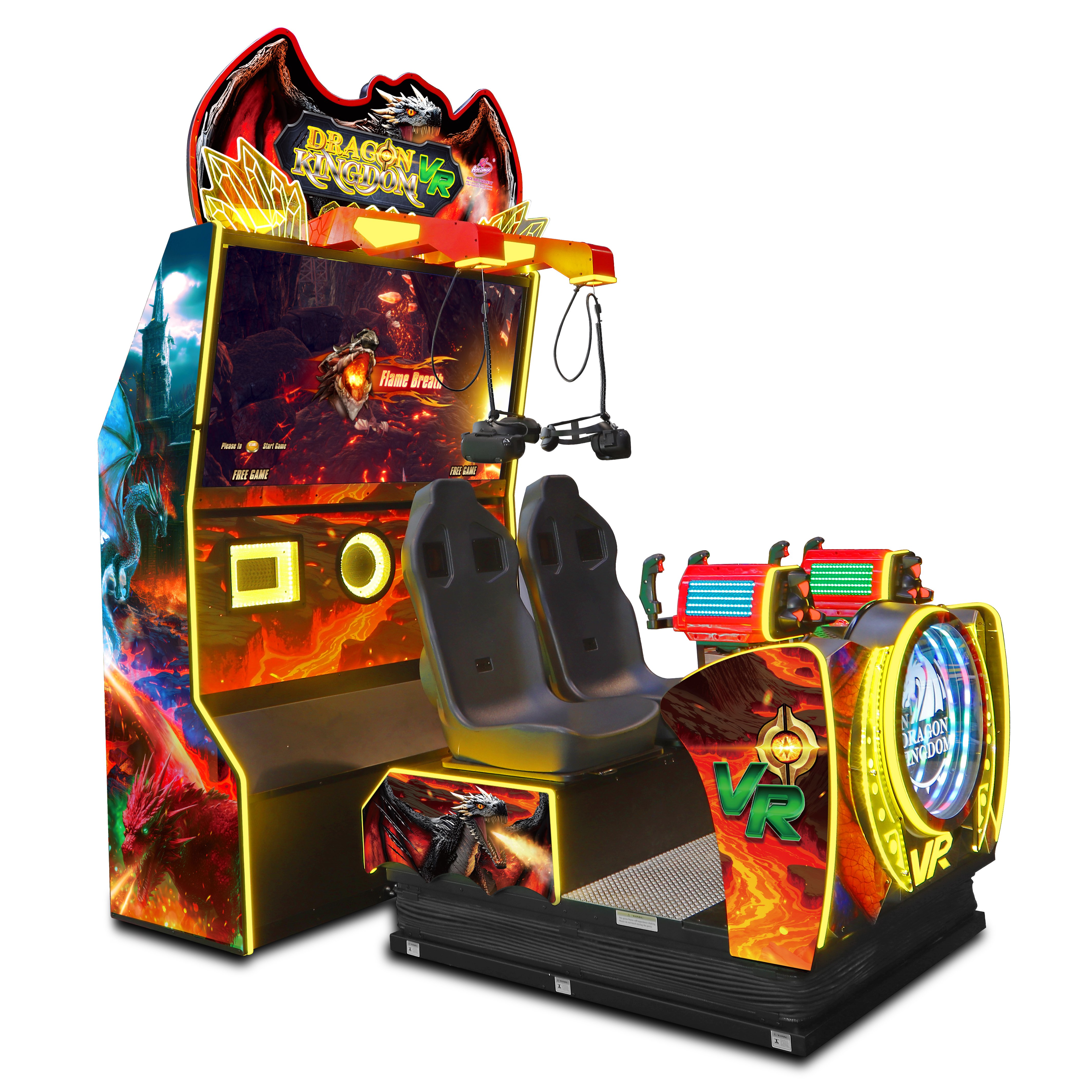
A motion seat looks impressive in a showroom and very different after six weeks of weekend traffic. One venue installed a three-axis platform near its entrance, and the queue was everything the sales pitch promised. The maintenance log told a second story: actuator mounts needed retorquing at week four, and a cable loom had chafed where it crossed the frame. Gaming machines with moving platforms are not just cabinets with a bigger screen; they are machines with a mechanical duty cycle. Buyers who evaluate gaming machines on visuals alone tend to discover the engineering later, usually during a busy period.
The first month of operation is the most informative period for any motion unit. Gaming machines reveal their real service burden once several hundred sessions have accumulated.
Motion adds a spectator effect that a static cabinet cannot match. A seat that pitches and rolls is visible from across the floor, so gaming machines of this type draw a crowd before anyone reads the marquee. That matters because throughput on these gaming machines is inherently lower than on a ticket unit; the crowd is part of the return, not a side effect. Gaming machines placed where spectators can stand without blocking an aisle convert that attention into a queue rather than an obstruction.
The log from those gaming machines contained three recurring items: mount torque, loom routing, and emergency stop testing. None appeared in the sales materials for the gaming machines. Gaming machines with a motion base concentrate load into a small number of fasteners, and vibration loosens them in a predictable pattern. A weekly visual check and a monthly torque pass on gaming machines cost little. Gaming machines that skip the pass eventually develop a knock in the frame, which is both a complaint generator and a safety signal.
Nausea on a simulator is rarely about the game content. It usually appears when the physical cue arrives after the visual one, or when the platform returns to centre faster than the scene suggests. Gaming machines with poorly tuned motion profiles produce that mismatch reliably. Ask for the latency budget between the render frame and the actuator command, and ride the gaming machines for a full session rather than a two-minute demonstration. Gaming machines that feel fine for thirty seconds can be uncomfortable by minute three.
Electric actuators, belts, and position sensors are consumables in a mechanical sense. A venue that buys gaming machines without a spare-parts list will wait on international freight for a sensor that costs little. Ask which components have a rated service interval and whether the controller reports a fault code when a position sensor drifts. Gaming machines that log their own actuator errors let a technician intervene before a seat is taken out of service on a Saturday.
On gaming machines, a two-axis platform handles pitch and roll; a three-axis design adds heave, and six-degree-of-freedom rigs use a Stewart platform with six actuators to control translation and rotation together. The controller converts game state into position commands, closes the loop with sensor feedback, and limits travel within a defined envelope. Gaming machines with more axes are not automatically more profitable: each axis adds cost, power draw, calibration work, and clearance. Gaming machines with two well-tuned axes often deliver a better return per square meter in a family venue than a full six-axis rig.
Synchronization is the core engineering problem. Visuals, seat motion, steering force feedback, wind, and audio all have their own latency, and the controller has to align them so a turn feels like one event. Gaming machines that let one channel drift produce a disjointed ride that players describe as “off” without being able to say why. Calibration routines should be repeatable after a firmware update, and gaming machines should return to a known neutral position on power-up and on an emergency stop.
ISO 17842-1 addresses design and manufacture of amusement devices, and ISO 17842-2 covers operation, maintenance, and use, both directly relevant to gaming machines with moving seats. ASTM F2291 gives design practice for rides and devices, while EN 13814 serves a similar role in European markets. ISO 13849-1 deals with safety-related parts of control systems, which covers the emergency stop circuit on a motion platform, and IEC 60204-1 addresses electrical equipment of machines. UL 22 remains the North American cabinet reference for amusement and gaming machines, and IEC 62368-1 covers display and computing hardware. NFPA 70 governs the branch circuit, OSHA 29 CFR 1910.147 covers control of hazardous energy during service, and ANSI Z535.4 sets the format for safety labels. ASTM F770 provides a structure for the written inspection record gaming machines should accumulate from commissioning onward.
Before ordering, request the platform envelope drawing, the power requirement, the emergency stop description, the rated component service intervals, and the spare-parts list. Ride a full session and note any cue mismatch. On delivery, verify that the emergency stop is reachable without moving the cabinet, that the platform returns to a defined neutral state, and that the floor is level and rated for the point loads. Then set a weekly check of mount torque, cable routing, and stop function, with a monthly calibration review. Gaming machines with a dated log are far easier to discuss with a supplier when a fault repeats, and gaming machines without one tend to lose a full weekend to guesswork.
No. A six-axis rig adds cost, power draw, calibration work, and clearance requirements. A well-tuned two-axis platform can suit a family venue better, because throughput and reliability matter more than range of motion. Compare gaming machines on sessions per hour, service burden, and footprint rather than on axis count alone, and ride a full session before deciding.
Most complaints trace to a timing mismatch between the visual scene and the physical cue, or to an aggressive return-to-centre profile. Ask for the latency budget between the render frame and the actuator command. A short demonstration can hide the problem, so a complete ride is the only useful test when comparing gaming machines side by side.
ISO 17842-1 and ASTM F2291 cover design of amusement devices, ISO 13849-1 addresses safety-related control functions such as emergency stops, and IEC 60204-1 covers machine electrical equipment. NFPA 70 governs the supply. Confirm that the stop is reachable, labelled to ANSI Z535.4, and tested during commissioning on all gaming machines in the order.
Position sensors, belts, fuses, and any actuator consumable the platform manufacturer lists with a service interval. Ask for the fault-code table so a technician can identify a drifting sensor before the seat is withdrawn. Gaming machines that report actuator errors reduce downtime far more effectively than gaming machines that only fail silently. Keep the kit against the cabinet serial number and review consumption after the first season.
A weekly visual pass on mounts, cable routing, and stop function, with a monthly torque and calibration review, suits most indoor venues. Log every check against the cabinet serial number. Include actuator fault codes in the same record, so a recurring pattern becomes visible before a seat is withdrawn during a weekend peak. ASTM F770 gives a defensible structure for written inspection and maintenance records across gaming machines with moving parts.
Yes. An uneven slab changes the neutral position and adds uneven load to the actuator mounts, which accelerates wear and shifts the motion profile. Check levelness and floor loading before delivery, and shim only within the limits the platform manufacturer allows. Gaming machines installed on an unprepared floor tend to develop frame noise within the first season.

Be the first to get our latest styles and offers.
#5 Building,No.6,HengFeng 6 Road,GangKou Town,Zhongshan,Guangdong P.R CHINA
Copyright © 2025 by ACE Amusement International Co., Ltd.
 EN





 Hot News
