A birthday party of eleven people arrived at a single-activity arcade with one clear plan. Four played, seven waited near the door, and the group left in under forty minutes. The same booking at a family entertainment center with redemption games, a competitive zone, a soft-play corner for younger siblings, and a prize counter stayed more than twice as long. Nobody bought a better cabinet; the second venue simply had somewhere for every member of the group to go. A family entertainment center wins on group composition, not on machine count, and that is a design decision made long before the first order is placed.
The comparison is useful because the spend per head differed less than the time on site. Length of stay changed what the group bought afterwards, which is where a family entertainment center quietly separates itself.
A floor built around one category forces everyone into the same queue. Teenagers dominate the competitive units, younger children lose interest, and adults become spectators with nothing to do. A family entertainment center that ignores that split loses the adult who would otherwise buy a second round of plays. Single-activity sites can still perform well in dense transit locations with high turnover, but the family entertainment center model is built for a different traffic pattern: longer visits by mixed-age groups, especially on weekends and during school holidays.
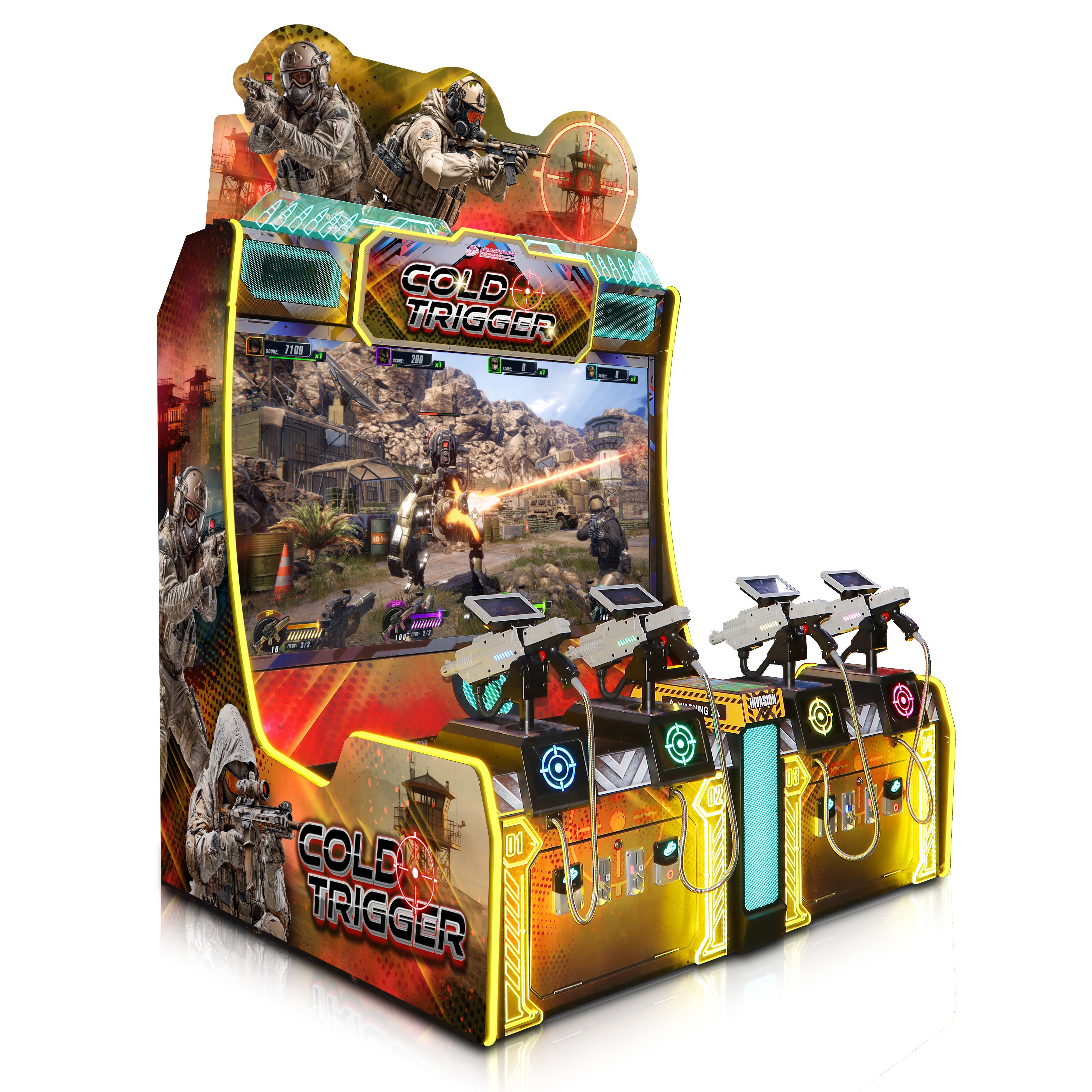
At the family entertainment center, the younger children moved to a low-intensity zone, the competitive players stayed at head-to-head units, and the adults drifted toward the prize counter. The group reassembled twice, which created two more purchase decisions. A family entertainment center with several attraction types also absorbs a failed preference: if one queue is long, the party redirects instead of leaving. ACE Amusement covers redemption, racing, shooting, and prize categories from one product range, which helps a family entertainment center build that variety without managing four separate spare-parts chains.
Adding an attraction is not the same as adding a reason to stay. A family entertainment center that installs a high-cost, low-throughput simulator in a corner can raise capex, insurance, and maintenance while barely changing session length. Each new category should be justified by which group member it serves and how long it keeps them on site. A family entertainment center that cannot name the guest segment for an attraction is buying square meters of idle floor with a large power draw attached.
Mixed venues create mixed noise. Simulator audio, ticket dispensers, and crowd reactions compete, and a family entertainment center that clusters all loud units together makes the quiet zone unusable. Queue footprints matter too: a line for a popular attraction can block an accessible route or the sightline to another zone. A family entertainment center needs the circulation plan reviewed as carefully as the game list, because a blocked aisle removes two attractions from play at once.
The useful metrics are average length of stay, spend per visit, and the share of groups using more than one attraction category. A family entertainment center with a well-judged mix usually scores well on the third, because the group does not have to agree on a single activity. Coin drop alone hides this: one high-throughput unit can dominate revenue while the family entertainment center actually earns its repeat visits from the variety around it. Track by group where a card system permits, and by zone otherwise.
Capacity is not a single number for a family entertainment center. A soft-play corner holds many children with low spend per head, a racing pair turns over quickly, and a simulator turns over slowly. Comparing plays per hour across zones misleads; compare contribution per square meter and contribution per operating hour instead. A family entertainment center that reviews these figures by daypart can shift staff toward the zone that is actually busy at 4 p.m. on a school day rather than the one that is busy on Saturday afternoon.
NFPA 101, the Life Safety Code, governs occupant load, exit access, aisle width, and travel distance, and a family entertainment center with several zones must keep every route clear even when a queue forms. NFPA 1, the Fire Code, covers extinguishers, decorations, and sprinkler coordination. NFPA 70 and OSHA 29 CFR 1910.303 set the electrical baseline for a mixed fleet, while OSHA 29 CFR 1910.95 addresses occupational noise exposure for staff working a full shift beside loud simulators. ADA requirements and ANSI A117.1 cover accessible routes and reach ranges, which a family entertainment center must preserve when adding a barrier or a prize counter. ISO 17842-2 addresses operation, maintenance, and use of amusement devices, and ASTM F770 gives a structure for written inspection records. UL 22 is the familiar reference for the cabinets themselves, and ISO 45001 supports a written safety procedure across a family entertainment center with multiple attraction types.
Audit the floor by group, not by cabinet. Map each attraction to the guest segment it serves, its queue footprint, its noise band, and its contribution per square meter. Log length of stay, spend per visit, and cross-zone usage for ninety days at the family entertainment center, then review by daypart. Check monthly that queues still leave accessible routes clear, that safety labels remain legible, and that anchors and cable strain relief are sound. A family entertainment center that changes one zone at a time can attribute the result; one that reshuffles everything at once learns nothing from the data.
A mixed-age party needs several things to do at once, or the whole group leaves when the first person gets bored. A family entertainment center with varied attractions lets members split and reassemble, which creates extra purchase moments. Machine count only describes capacity; it says nothing about whether the group can stay together on site for an extra hour.
Yes, in high-turnover locations such as transit hubs or dense tourist strips where visits are short by nature. The model depends on volume rather than dwell time. A family entertainment center targets a different pattern, with longer weekend visits and repeat bookings, so comparing the two on plays per machine alone gives a misleading answer about which format fits a given site.
Manual observation works: record entry and exit times for a sample of groups across several dayparts, and note how many zones each group used. A family entertainment center with a card system can derive the same figures from play timestamps. Either way, sample weekends and school days separately, since the mix of groups changes sharply between them.
Buying an expensive, low-throughput attraction without naming the guest segment it serves. A family entertainment center then carries higher capex, insurance, and maintenance with little change in length of stay. Every new zone should be justified by which member of the group it keeps on site and by a measured contribution per square meter after a full season.
NFPA 101 covers occupant load, exit access, and aisle width, and NFPA 1 adds fire-safety requirements. ADA and ANSI A117.1 cover accessible routes and reach ranges. A family entertainment center should verify the plan with the local authority having jurisdiction, since a queue that forms only on Saturdays still has to leave the required route clear.
Review the data quarterly and change one zone at a time. Ninety days of length of stay, spend per visit, and cross-zone usage gives a family entertainment center a usable baseline that covers weekends and school terms. Moving several attractions at once destroys that baseline, so the next review cannot show which change actually produced the result.

Be the first to get our latest styles and offers.
#5 Building,No.6,HengFeng 6 Road,GangKou Town,Zhongshan,Guangdong P.R CHINA
Copyright © 2025 by ACE Amusement International Co., Ltd.
 EN


 Hot News
