
 EN

How to Evaluate the ROI of Arcade Games for Sale Based on Venue Type and Demographics?
Buying an arcade game for sale is a capital-allocation decision, not simply a question of what looks exciting on the show floor. The same machine can perform very differently in a compact café, a family entertainment center (FEC), a bowling venue, or an adult-oriented social venue. Before choosing an arcade game for sale, estimate how the venue’s traffic, dwell time, audience, operating costs, and floor plan interact.
As operators, we have found that a useful ROI conversation starts with a modest forecast and then asks what has to be true for it to hold. Industry guidance from IAAPA points to a directional target of at least US$200 in weekly revenue per game and suggests that appropriately placed machines may recover their purchase cost in roughly 12–18 months. That is not a promise for every location; it is a benchmark to test against local data.
Build an ROI model before selecting an arcade game for sale
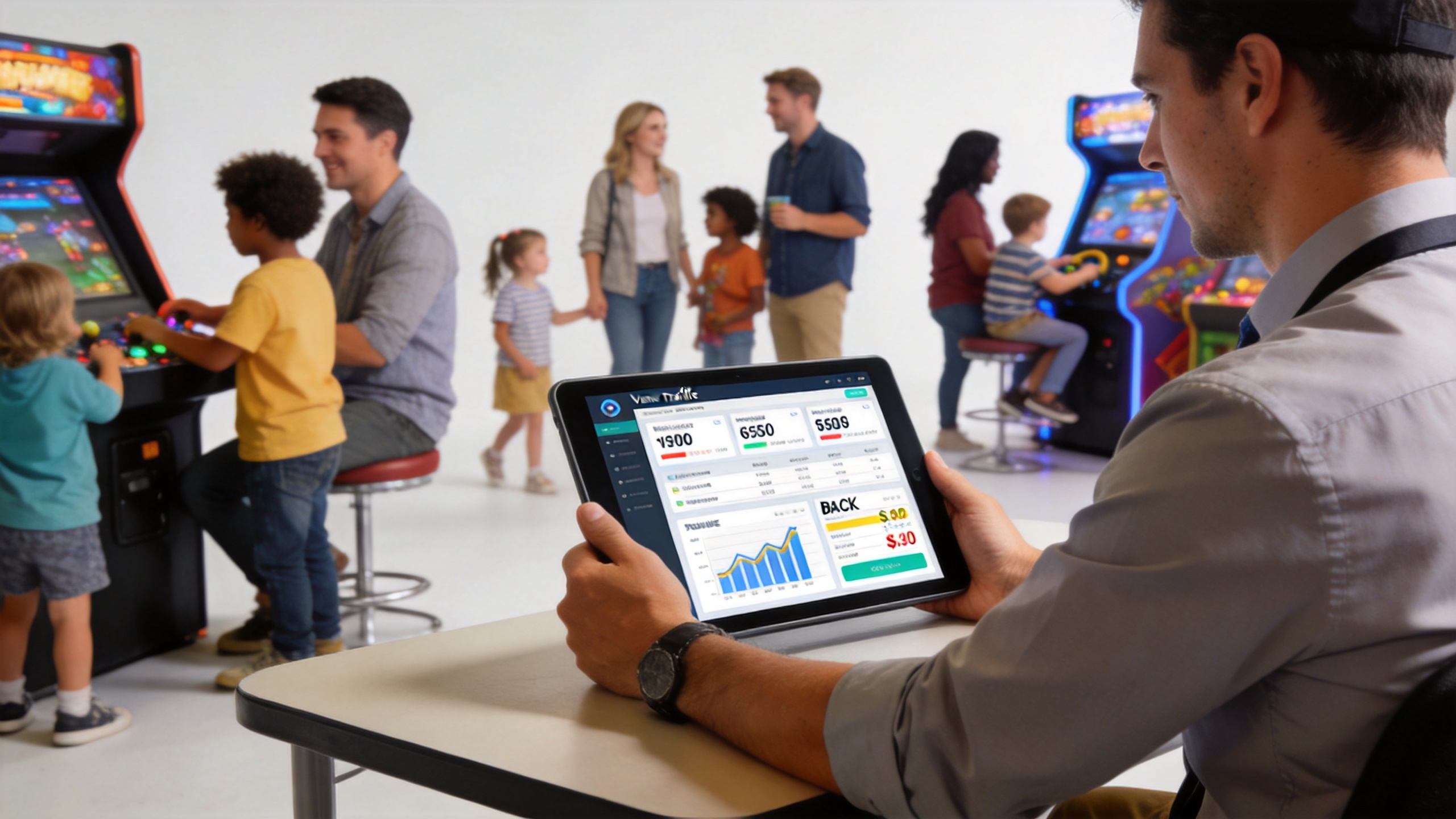
Start by separating cash collected from economic return. For each arcade game for sale, calculate a conservative monthly contribution:
Monthly contribution = monthly game revenue − prize cost − payment processing − routine maintenance − allocated labor − allocated floor cost.
Then calculate simple payback:
Payback months = installed cost ÷ monthly contribution.
The installed cost should include freight, import charges where applicable, site preparation, card-reader integration, commissioning, spare parts, and any themed signage. The purchase price of an arcade game for sale alone can make a project seem more attractive than it is. A venue with high rent should also assign a realistic floor-cost allowance to each footprint; a compact game with steady turns can be more useful than a larger attraction that blocks circulation.
Run three scenarios—cautious, expected, and strong—instead of relying on one forecast. Change plays per day, average spend per play, downtime, prize cost, and service expense. If the cautious scenario creates an unworkably long payback period, reconsider the machine, placement, or venue mix.
Match venue type to the revenue mechanism
Family entertainment centers
For an FEC, an arcade game for sale should support shared family time, repeat play, and a reason to stay longer. Redemption titles, approachable skill games, and visible merchandisers often fit because adults can understand the value exchange while children can participate quickly. IAAPA describes high-performing arcades as heavily redemption-led, with instant-win merchandisers supplying additional variety. Use that guidance to review the floor mix, not to duplicate a fixed percentage in every location.
Track revenue by weekday, weekend, party booking, and school-holiday period. A game that looks average on a daily basis may still contribute strongly during birthday-party peaks. Pair the ROI forecast with prize redemption rates and staff time at the counter. When evaluating an arcade game for sale for this setting, include the effect on food, parties, and return visits, but record those effects separately from game revenue so the core machine economics remain visible.
Shopping-mall and transit-adjacent sites
These locations often depend on short visits and passers-by. An arcade game for sale needs an understandable objective, fast start-up, and strong visual presence from the aisle. Estimate conversion as a chain: passers-by × stop rate × play rate × average plays. A machine may have plenty of footfall yet weak ROI if guests cannot see what to do, queues are awkward, or payment takes too long.
Choose a small pilot cluster and compare its performance by entrance, escalator, food court, and cinema adjacency. In this venue type, throughput and downtime generally matter more than a deep session experience. Inspect service access before you commit: a machine that cannot be repaired quickly can lose its most valuable trading hours.
Bowling, cinema, and eatertainment venues
Here the opportunity is often dwell time. Guests may wait for a lane, a film, a table, or friends. An arcade game for sale should fit a 2–10 minute window and invite groups to watch or challenge one another. Measure revenue by wait-time band and by daypart. For instance, an adult-heavy evening crowd may respond to competitive, social, or skill-oriented play, while an earlier family period may need simpler shared games.
Do not give all credit to a machine that happens to sit next to the queue. Rotate comparable games through comparable locations when practical. That distinguishes product appeal from placement advantage and creates a more defensible ROI forecast for the next arcade game for sale.
Bars, resorts, and adult social venues
Adults usually evaluate the experience through social interaction, visual presentation, and low-friction group participation. For this venue type, an arcade game for sale should suit the atmosphere and avoid creating a maintenance burden during busy service periods. Revenue per square foot and repeat group visits can matter as much as play count. Use evening and event-specific data rather than borrowing family-venue averages.
Segment the audience before you buy
Venue demographics change both the game mix and the financial model. A practical segmentation framework includes families with younger children, families with pre-teens, teenagers, young adults, and adults. It is only a starting point; your card-system and POS records should refine it.
- Families with younger children: Favor clear rules, accessible controls, short sessions, and games that let an adult help. Evaluate prize expense and parental perception of value.
- Families with pre-teens and teenagers: Look for skill progression, friendly competition, and reasons for a second play. Compare repeat-play rates, not only first-play revenue.
- Young adults: Test social visibility, competitive formats, and content freshness. Newness can lift attention, but refresh cost should be part of ROI.
- Mixed-age audiences: Build a portfolio. One arcade game for sale rarely addresses every group as effectively as a balanced line-up.
Demographic fit also affects capacity. A title designed for one player may underperform where parents and siblings want to participate together. Conversely, a high-footprint multiplayer unit may not justify its space in a venue dominated by solo, quick-stop traffic.
Use operating data to validate an arcade game for sale
For every arcade game for sale under consideration, ask the supplier for practical ownership information: dimensions, electrical needs, recommended clearance, payment-system compatibility, consumables, typical maintenance tasks, and availability of parts. ACE Amusement’s broad equipment portfolio can help procurement teams compare redemption machines, arcade games, video simulators, and other amusement equipment within one sourcing discussion. That may simplify a multi-category purchase, but each unit should still pass its own venue-level ROI test.
After installation, review weekly revenue, plays, revenue per occupied square foot, uptime, maintenance tickets, prize cost, and nearby-machine effects. Establish a 30-, 60-, and 90-day review. The early review checks installation and placement; the later reviews show whether novelty is fading or whether repeat use is building.
A practical decision checklist
- Define the venue’s primary audience by daypart, not only by annual average.
- Forecast cautious, expected, and strong plays-per-day scenarios for each arcade game for sale.
- Add all installed and lifecycle costs, including floor space and downtime.
- Compare the game with the existing mix for overlap, queue behavior, and prize liability.
- Run a pilot or phased purchase when local data is limited.
- Set an evidence-based review point before ordering additional units.
The right arcade game for sale is the one whose economics fit a specific venue and audience—not simply the machine with the most impressive headline forecast. A disciplined model, careful demographic fit, and routine operational review give buyers a clearer basis for expanding an arcade floor.


 Hot News
